
Why Your Ankle Keeps Rolling — And Why the Problem Isn’t Actually Your Ankle
By Dr. Matt Heisig, DC | Athlete Lab Performance Chiropractic | Long Beach, CA
You’re playing beach soccer out in the Belmont Shores sand on a Sunday morning. You plant your foot to cut left, your ankle rolls outward, and you feel that familiar pop. You hobble off, ice it, tape it up, and tell yourself you’ll be fine by next weekend.
And you probably will be.
Until it happens again.
If you’ve sprained the same ankle two, three, or four times — welcome to one of the most common and most misunderstood injury patterns in sports. Almost half of all sports-related injuries are ankle sprains, and the vast majority of athletes who sprain their ankle once will do it again. That recurrence rate isn’t bad luck. It tends to be a structural problem that nobody addressed the first time.
What Actually Happens When You Sprain Your Ankle
An ankle sprain occurs when the foot rolls inward or outward beyond its normal range and the ligaments on the outside of the ankle get stretched or torn. The most common version — the lateral (inversion) ankle sprain — involves the anterior talofibular ligament (ATFL) and sometimes the calcaneofibular ligament (CFL). These structures are responsible for keeping your ankle from rolling outward.
There are three grades of severity:
Grade I — ligament stretching, mild swelling, you can still walk
Grade II — partial ligament tear, significant swelling and bruising, walking is painful
Grade III — complete ligament rupture, major instability, usually requires more aggressive intervention
Most beach athletes deal with Grade I and II sprains repeatedly. They rest it, tape it, and get back out there — without ever understanding why the ankle keeps giving way.
The Real Reason It Keeps Happening
Here’s what the RICE protocol and a week of rest don’t fix: proprioception.
Proprioception is your body’s ability to sense where your joints are in space — its position sense. When you sprain your ankle, you don’t just damage ligaments. You damage the mechanoreceptors embedded in those ligaments — the sensory nerve endings that tell your nervous system where your foot is relative to the ground at any given moment.
When those receptors are damaged and never properly retrained, your ankle loses its ability to self-correct in real time. The next time you plant your foot on uneven sand or make a quick lateral cut, the nervous system doesn’t respond fast enough to prevent the roll. The ligaments take the load again. You sprain it again.
This is why taping helps in the short term — it provides external proprioceptive input — but it doesn’t fix the underlying deficit. You’re compensating for a problem, not solving it.
Here's something that surprises most athletes: research shows that repeated ankle sprains on one side can create neurological deficits on the opposite ankle — a 2019 study found that individuals with recurrent ankle sprains demonstrated postural instability and neuromuscular control deficits on their unaffected side. Because those motor feedback signals are processed centrally in the brain, the compensation patterns don't stay local. Your "good" ankle may already be affected in ways you can't feel yet — which is why a thorough assessment of both sides matters, even when only one has been visibly injured.
The good news — proper rehab works bilaterally too. Retraining the proprioceptive system on the injured side has positive carryover effects on the uninjured side as well.
Why Sand Makes This Worse
Not all athletes are playing in the sand — but as a fellow weekend sand sport participant myself, I can tell you firsthand: beach volleyball, beach soccer, and flag football on sand are genuinely harder on your ankles than grass or hardwood. And not just because the surface is uneven.
Sand requires constant micro-corrections from your ankle and foot with every step. Your stabilizing muscles have to work significantly harder to maintain balance and generate force. For an ankle with compromised proprioception and ligament integrity from a previous sprain, that demand is exactly what drives re-injury.
Add in the fact that most Long Beach beach athletes are playing multiple hours of sport on a Sunday after a week of sitting at a desk — cold, stiff, and without a meaningful warm-up — and you have a setup that makes ankle re-injury almost inevitable.
The Upstream Problem Nobody Looks At
Here’s the part that surprises most athletes: chronic ankle sprains often have a root cause that has nothing to do with the ankle itself.
In the PRI world, we look at the entire kinetic chain — how your foot, ankle, knee, hip, pelvis, and ribcage relate to each other structurally. As I've written about in previous posts, the body's compensation patterns don't stay local — a shoulder injury affects the opposite shoulder, and a hip asymmetry affects how your ankle loads the ground. A pelvis that’s shifted or rotated asymmetrically changes how load is distributed through your lower extremities. A hip that’s not loading correctly changes how your foot contacts the ground. A foot that’s consistently supinating (rolling outward) on contact is often doing so because of something happening upstream at the hip or pelvis — not because of weak ankle ligaments.
This is why two athletes can have the same ankle sprain and one recovers fully while the other keeps re-injuring: the one who keeps re-injuring has a structural pattern driving the problem that nobody ever found.
Quick Self-Check: Is Your Ankle Structurally Vulnerable Right Now?
Stand barefoot on one foot for 10 seconds. Then switch.
• Does one side feel noticeably less stable than the other?
• Does your ankle wobble or compensate more on one side?
• Does the foot that sprains most often turn out more at rest than the other?
If yes to any of these — your proprioceptive system is already compromised on that side, or you have an existing asymmetry that’s loading that ankle differently. Both are worth addressing before the next sprain happens rather than after.
What Actually Fixes It
Effective ankle sprain rehab has three components that most treatment protocols either rush through or skip entirely:
1. Clear the tissue
Soft tissue work to address the swelling, adhesion, and restricted mobility that builds up around the ankle, subtalar joint, and lower leg after a sprain. RockFloss compression band flossing is particularly effective here — it restores joint mechanics quickly and reduces swelling that limits range of motion.
2. Retrain Proprioception
This is the piece that determines whether you sprain it again — and it’s the piece most athletes skip entirely.
After a sprain, the mechanoreceptors in your ankle ligaments need to be systematically rechallenged and rebuilt. At Athlete Lab we use Propriofoot graduated balance platforms — a progression-based training system that starts with a stable base and works through increasing levels of instability, forcing the nervous system to rebuild its position sense from the ground up.
The progression matters. Jumping straight to single-leg balance on an unstable surface before the basic sensory pathways are restored is like trying to run before you can walk — you’re training compensation, not proprioception. The Propriofoot system’s graduated levels mean we meet your ankle where it actually is, not where you think it is.
This doesn’t happen passively on a treatment table. It happens on your feet, with progressive loading, until your ankle can self-correct faster than the sprain mechanism can occur.
3. Address the upstream cause
If there’s a hip, pelvis, or ribcage asymmetry driving how your foot loads the ground, it needs to be identified and corrected. PRI-based repositioning work addresses the neurological patterns that predispose one ankle to loading asymmetrically. Without this piece, you’re managing symptoms indefinitely.
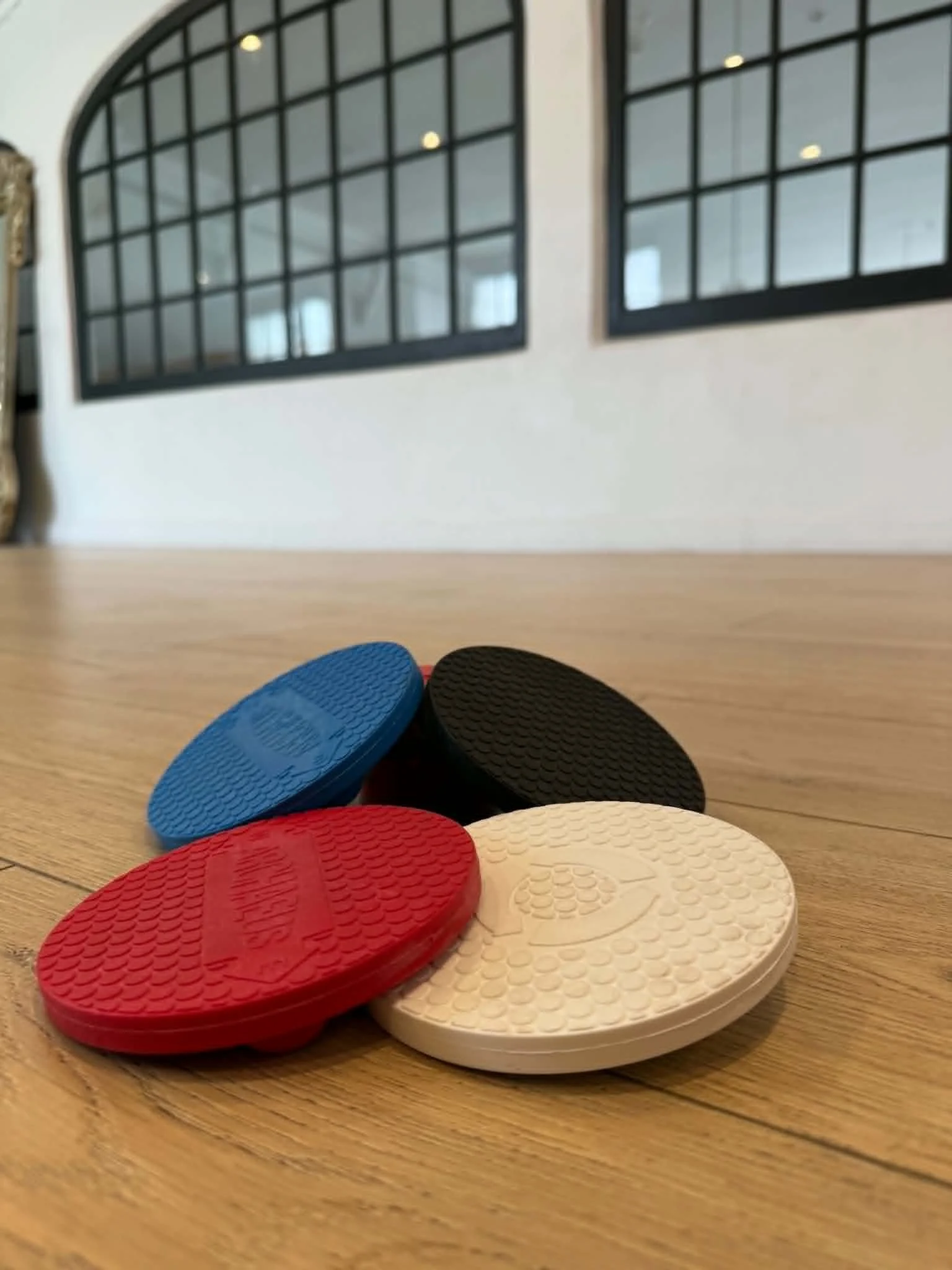
Propriofoot graduated proprioceptive training platforms used at Athlete Lab Performance Chiropractic. Each color represents a progressive level of instability — from the most stable base to the most challenging — systematically rebuilding the sensory feedback loop between the ankle and the nervous system after a sprain.
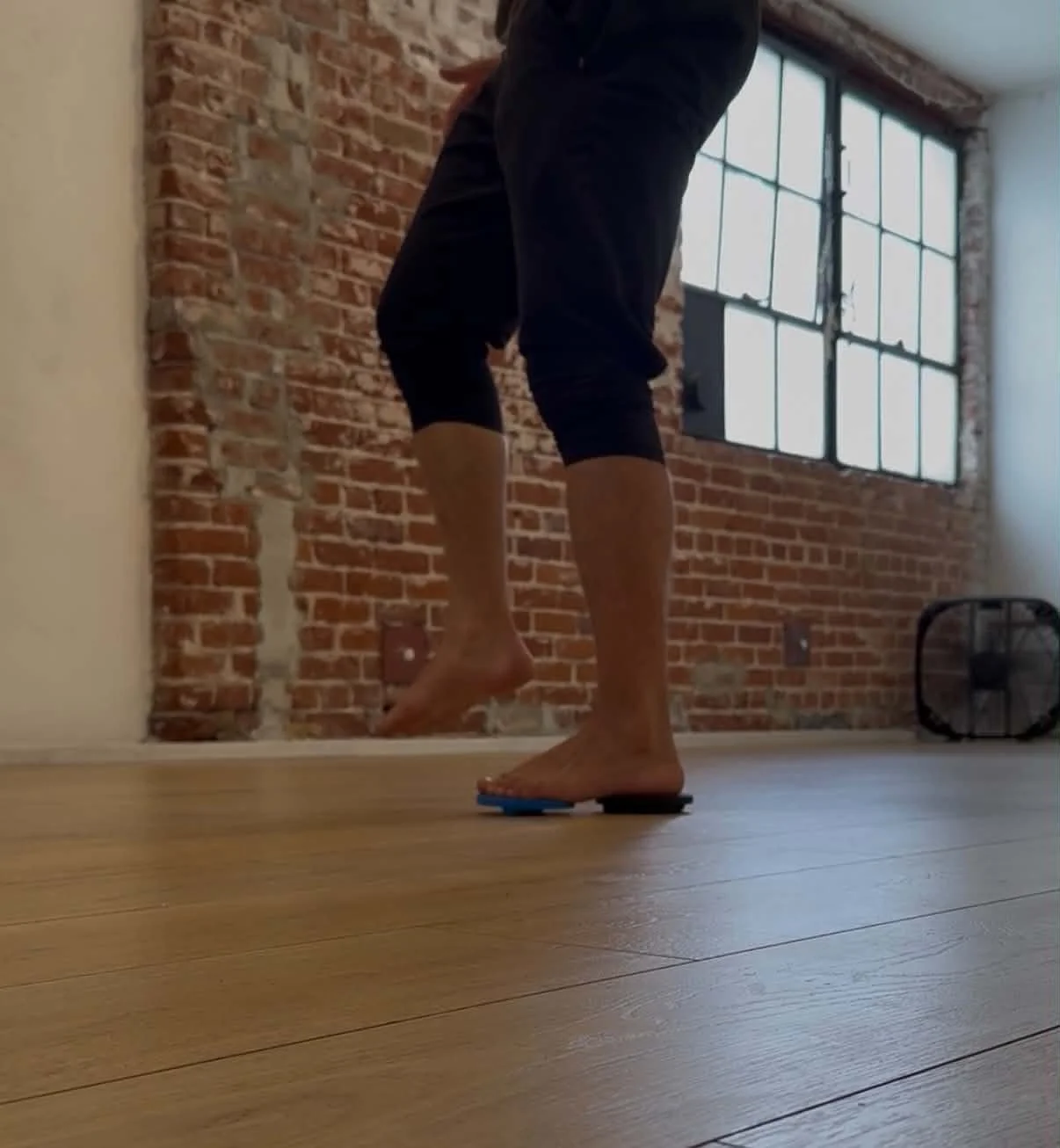
Single-leg balance training on a Propriofoot proprioceptive platform during an active rehab session at Athlete Lab Performance Chiropractic in Long Beach, CA. This progressive stability work is a core component of chronic ankle sprain treatment — retraining the mechanoreceptors that are damaged during a sprain and never properly rehabilitated through rest alone.
The Bottom Line
An ankle sprain is not just a sprained ankle. It’s a proprioceptive deficit, a potential structural pattern, and — if not addressed properly — a recurring problem that compounds with every re-injury. Ligaments that are repeatedly sprained develop scar tissue, lose tensile strength, and create progressively more instability over time.
The athletes who sprain their ankle once and never again are the ones who did the full work — not the ones who iced it and taped it and hoped for the best.
If you’re on your second, third, or fourth ankle sprain, the answer isn’t more tape. It’s finding out what’s actually driving it — and fixing that.
Dealing with a recurring ankle sprain? Book your Initial Evaluation at Athlete Lab Performance Chiropractic in Long Beach. No referral needed — just show up ready to move.
Gillman SF. "The Impact of Chiropractic Manipulative Therapy on Chronic Recurrent Lateral Ankle Sprain Syndrome in Two Young Athletes." Journal of Chiropractic Medicine. 2004;3(4):153-159.
Lee JH, Lee SH, Choi GW, Jung HW, Jang WY. "Individuals with recurrent ankle sprain demonstrate postural instability and neuromuscular control deficits in unaffected side." Knee Surgery, Sports Traumatology, Arthroscopy. 2019;27(8):2500-2508. PMID: 30291398.
About the Author: Dr. Matt Heisig is a Doctor of Chiropractic and founder of Athlete Lab Performance Chiropractic in Long Beach, CA. A graduate of Southern California University of Health Sciences with a sports medicine emphasis, Dr. Matt utilizes PRI methodology, active movement rehab, and performance-focused care for athletes at all levels. He sees patients at Long Beach Rising on weekends.
Athlete Lab Performance Chiropractic is located inside Long Beach Rising at 205 E Anaheim St, Long Beach, CA 90813. Dr. Matt Heisig, DC sees patients on weekends and accepts HSA/FSA.